


Registered Migration Agent · MARN 2218004
Australian migration,
from visa strategy to grant
You deal directly with a Registered Migration Agent. From working out which visa fits, through document preparation and case management, one person sees it through.
M2A Migration · Registered Migration Agent
Welcome. I am a Registered Migration Agent.
- It is fine not to know where to start. We will work through it one document at a time.
- My advice comes from hands-on work in Employer Sponsorship and transitions to permanent residence.
- You will hear from me as things move, so you are never left wondering where your case stands.
- Consultations are available in person, by phone, KakaoTalk, email or Zoom. No question is too small.

MARN 2218004
An OMARA-registered agent advises on and runs your case personally
All visa categories
Employer Sponsored · Skilled Migration · Family Visa
ART review
We also take on refused and cancelled cases
Korean · English
Documents in English, advice in the language you prefer

Where do you start with Australian migration in Sydney?
There are broadly three routes to Australian permanent residence: sponsorship by an employer (subclass 482 and 186), points earned on your own qualifications and experience, and family.
Most people ask “which visa should I apply for”, but the question that has to be answered first is “which pathways are actually open to me”. For the same occupation, age, English score and history in Australia can change the answer completely.
Start with whichever of the three below looks closest to your situation. If you are not sure which one that is, that is fine. We will work it out together in a consultation.
- 01
Employer sponsored (482 · 186)
You have a job with an Australian company, or an employer willing to hire you
A business that holds sponsorship approval nominates you for a specific position, and you are granted a work visa. Transitioning to permanent residence after a qualifying period is the usual course. The employer and the applicant each have documents to prepare, so aligning both timelines matters.
Learn more - 02
Skilled migration (189 · 190 · 491)
You want to apply on your own experience and qualifications, without a sponsor
You settle an occupation code, obtain a skills assessment, then calculate points on age, English, work experience and qualifications. Above the threshold you lodge an EOI and wait for an invitation. State nomination or regional residence can make up a points shortfall.
Learn more - 03
Family and partner (Partner Visa)
You have a spouse or family member who is an Australian citizen or permanent resident
Your spouse or de facto partner sponsors the application. The evidence establishing that the relationship is genuine determines the outcome, and it is built across four pillars: financial, household, social and commitment.
Learn more
Beyond these three we also handle student visas, visitor visas, and review of refused or cancelled cases at the ART.
Why speak with M2A Migration?
There are thousands of registered migration agents in Australia. Here are seven reasons to choose us.
- 01
Your agent does not change mid-case
A Registered Migration Agent handles your case personally from the first consultation to the grant. There is no arrangement where the principal takes the consultation and someone else does the work. If a question comes up during the process, you ask the person you first spoke to.
- 02
We are honest about your prospects
Where a case works, we explain why; where it is difficult, we say so first. We will not suggest lodging and hoping. Government charges are not refunded on refusal, so an application without prospects costs you both time and money.
- 03
We work beyond refusals
We take on the cases that do not resolve through the ordinary process: ART review, Schedule 3, PIC 4020, section 501. We are happy to look at cases refused elsewhere. Review applications carry deadlines, though, so contact us quickly if you have received a notice.
- 04
We understand both the applicant and the employer
We have acted for both. Sponsorship and nomination split the preparation between the company and the applicant; seeing both sides at once means fewer requests going back and forth, and shorter processing.
- 05
We advise in two languages
Documents and correspondence with the Department are handled in English, while advice and consultations can be in Korean. You will never sign something without understanding what it is, and you do not need to arrange an interpreter.
- 06
You know the cost up front
After confirming the requirements at the consultation, we give you a written quote covering the work to be done and the cost. If additional steps become necessary during the case, we explain them and obtain your agreement before any cost is incurred.
- 07
We are registered
As an OMARA-registered Registered Migration Agent we are bound by the Code of Conduct. Anyone can verify our registration by MARN (2218004), and complaints can be made to OMARA.
How we work with you
Four steps, from first consultation to grant.
- 1
Consultation
Start however suits you, whether in person, by phone, KakaoTalk, email or Zoom. We listen to your situation and set out the pathways open to you.
- 2
Eligibility review
We check your circumstances against each requirement to work out which visa gives you the best position. Where something will not work, we tell you why first.
- 3
Documents and lodgement
You get a written list of the documents required, and guidance on how to fill any gaps. We prepare and lodge the application on your behalf.
- 4
Case management and grant
Lodging is not the end.
We respond to requests for further information (RFI) and interviews, and keep you updated as the case progresses.
Not a lodgement service. We see it through with you
A visa application looks like gathering documents and submitting them, but in practice the outcome turns on which documents you prepare and in what form. The same facts are assessed differently depending on how they are evidenced.
We work with you across the whole process: eligibility review, document preparation, lodgement, and responses to requests for further information and interviews. While you are waiting on a decision, we keep you informed.

Case review
We check your age, qualifications, experience and English score against each requirement in turn, and give the reasons for and against equal weight.

Strategy
We set out every available pathway side by side, including making your partner the primary applicant and what the alternatives are if the current route closes.

Documents
You get a list of required documents with the issuing body and validity period for each. Anything needing NAATI translation or certification is flagged separately.

Lodgement
We prepare and lodge the application on your behalf, arranging the documents in the order a case officer reads them and reviewing once more before submission.

Case management
Lodging is not the end. We handle requests for further information and interviews, and keep you updated even where assessment runs long.

Employer advice
Starting at the planning stage is faster than after the hire is decided. A position description that does not match the ANZSCO code is hard to unwind later.
What to check before you engage anyone
Choosing a migration agent comes down to trust. So we have started with the things you can verify yourself, with the official bodies rather than on our word.
OMARA-registered migration agent
Representing someone in a visa application in Australia requires OMARA registration. Our registration number is MARN 2218004, and anyone can check its status directly.
Check the registerBound by the Code of Conduct
Registered migration agents must comply with the OMARA Code of Conduct, which sets the standards for advice, fees and the information provided to you.
Read the CodeCosts in writing, in advance
After confirming the requirements at the consultation, we give you a written quote covering the work and the cost. If additional costs arise, we explain them before they are incurred.
What you tell us stays confidential
Personal information and documents disclosed in a consultation are not used for any purpose other than your application, including if you decide not to proceed.
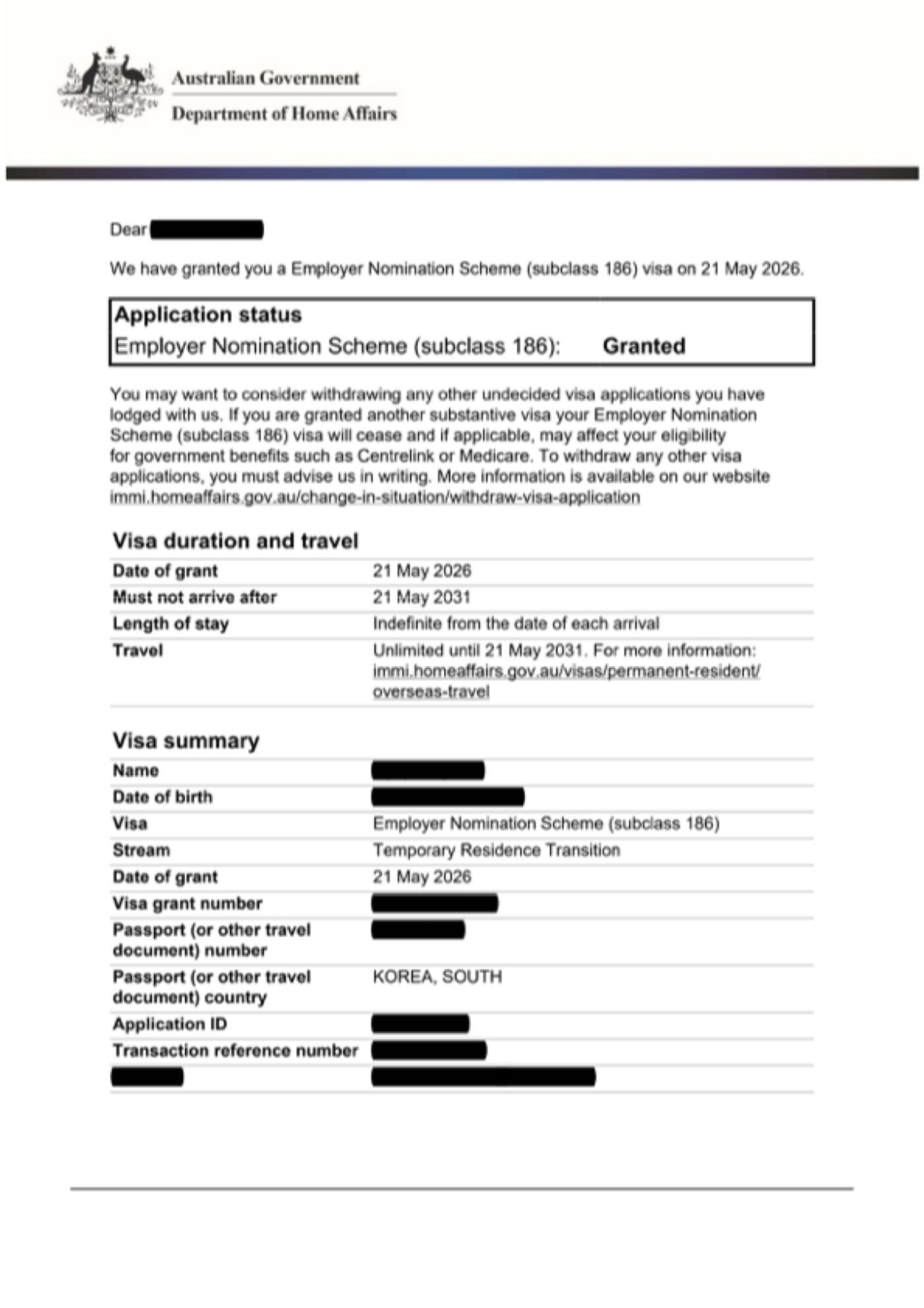
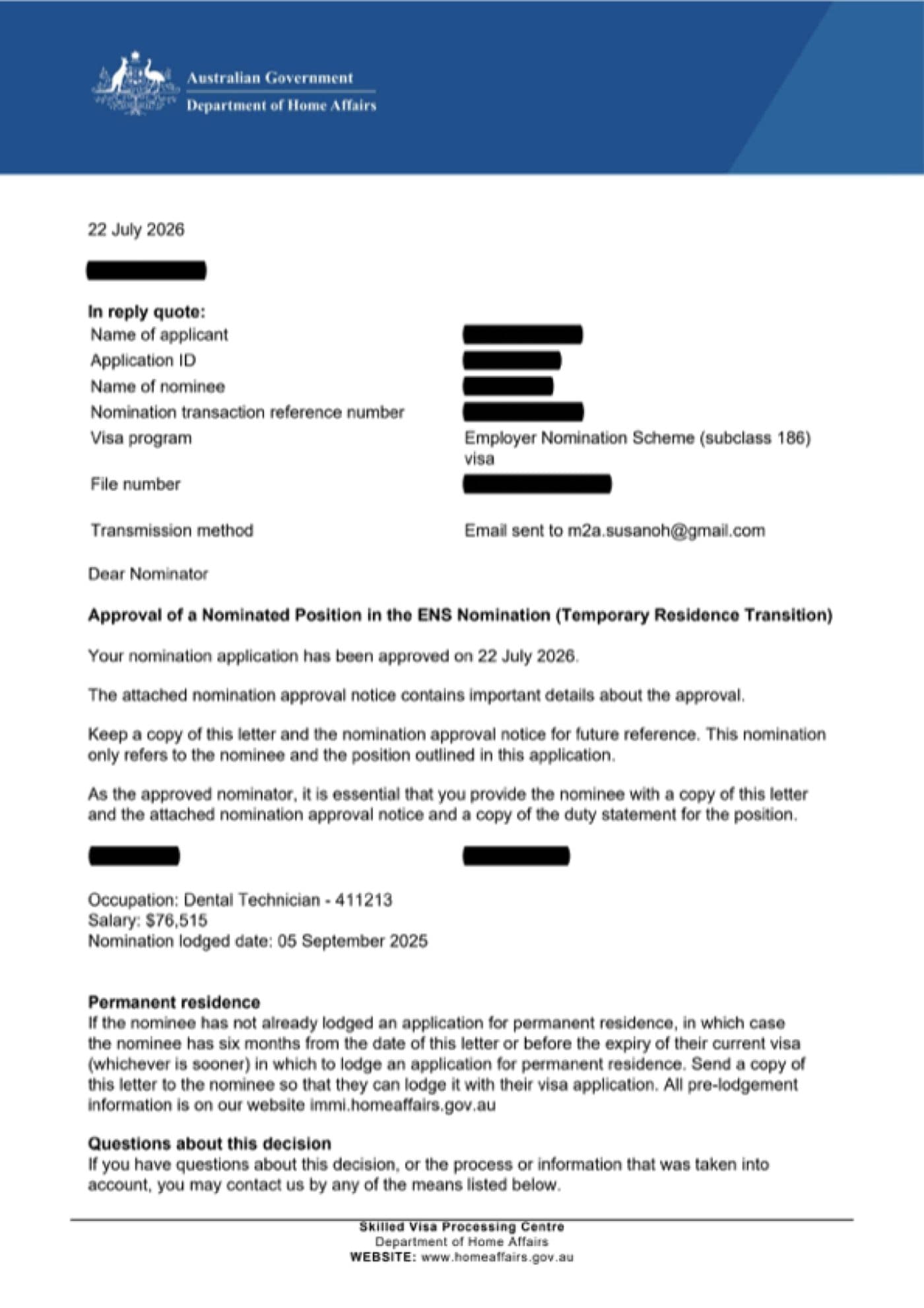
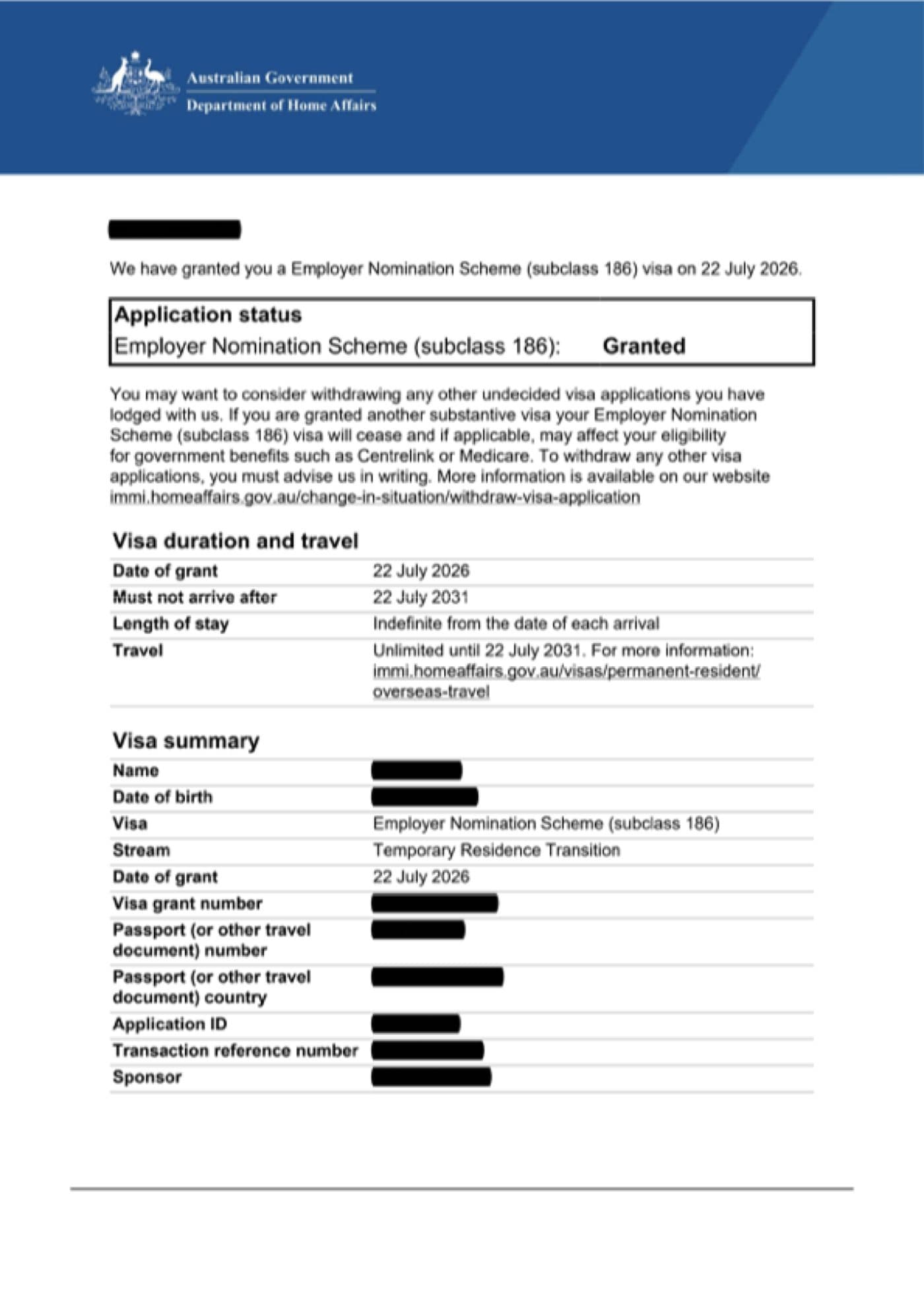
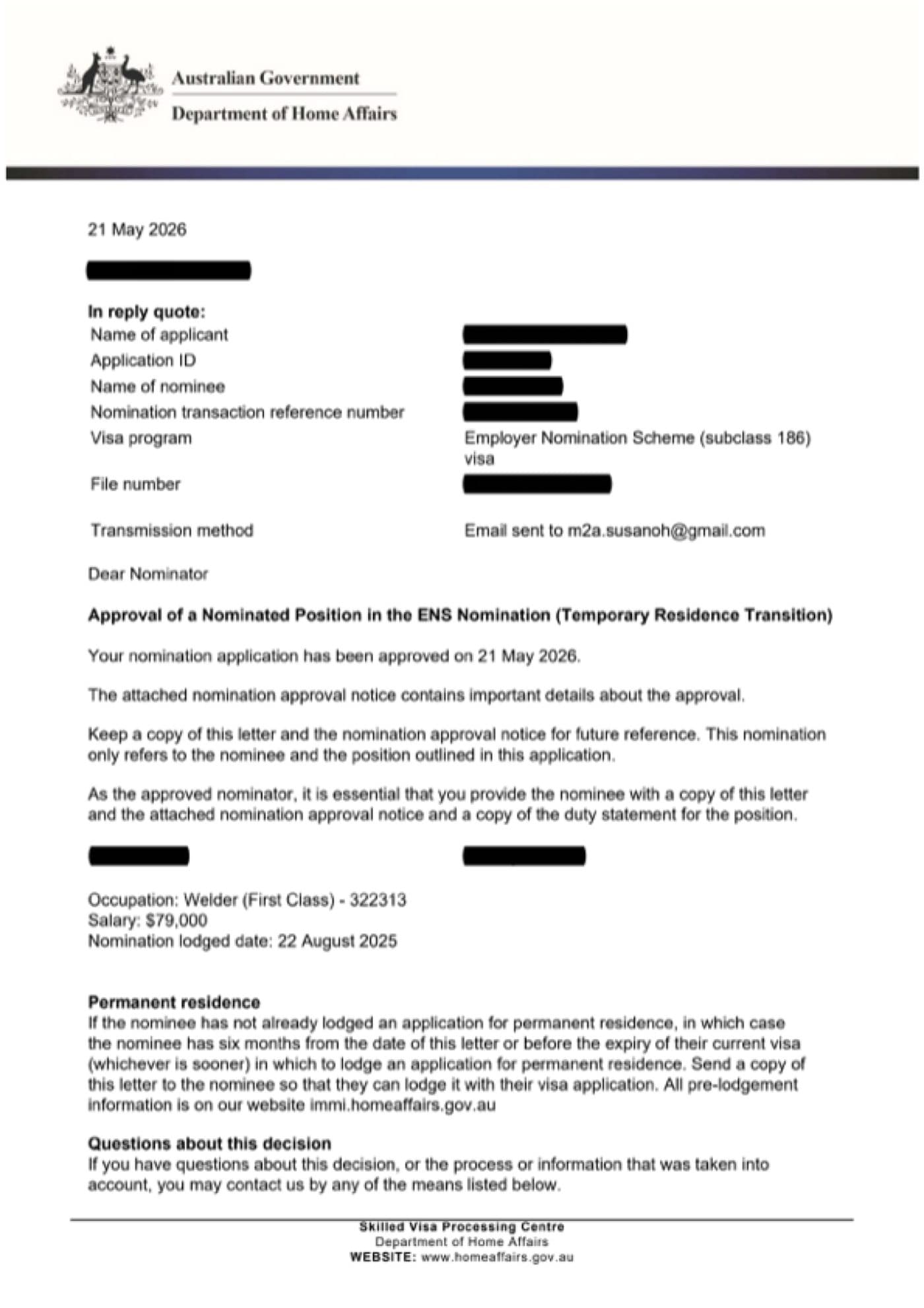
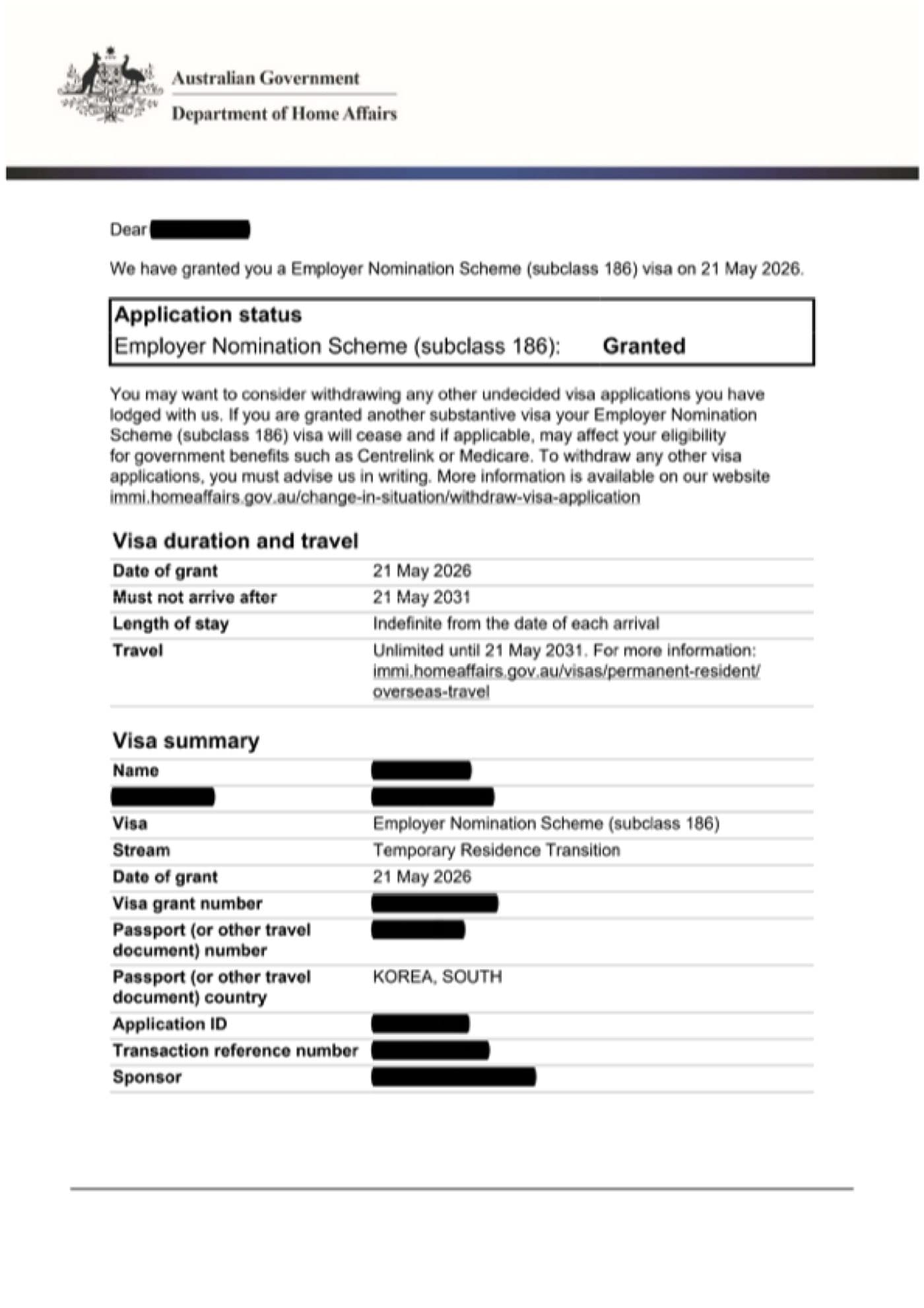
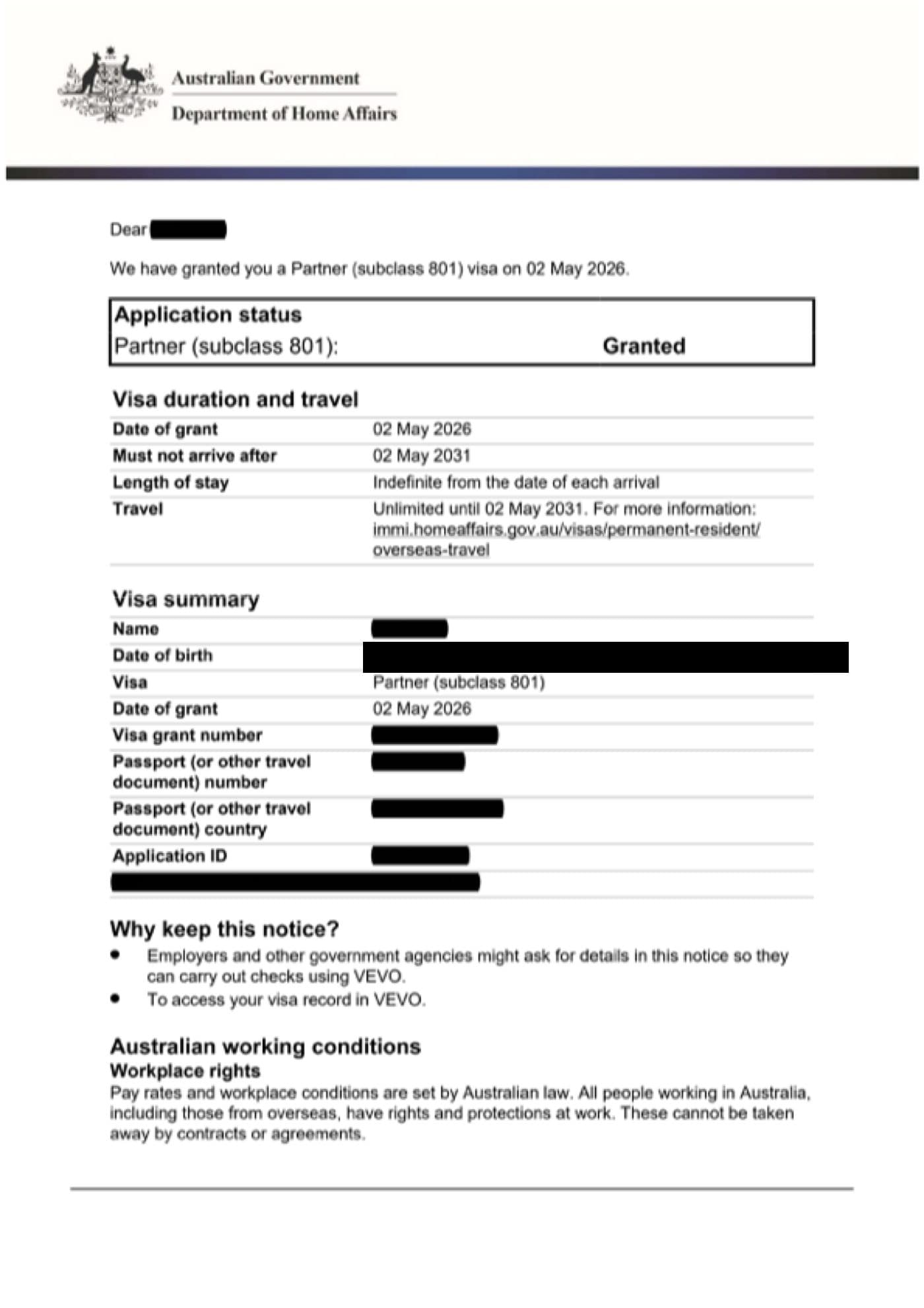
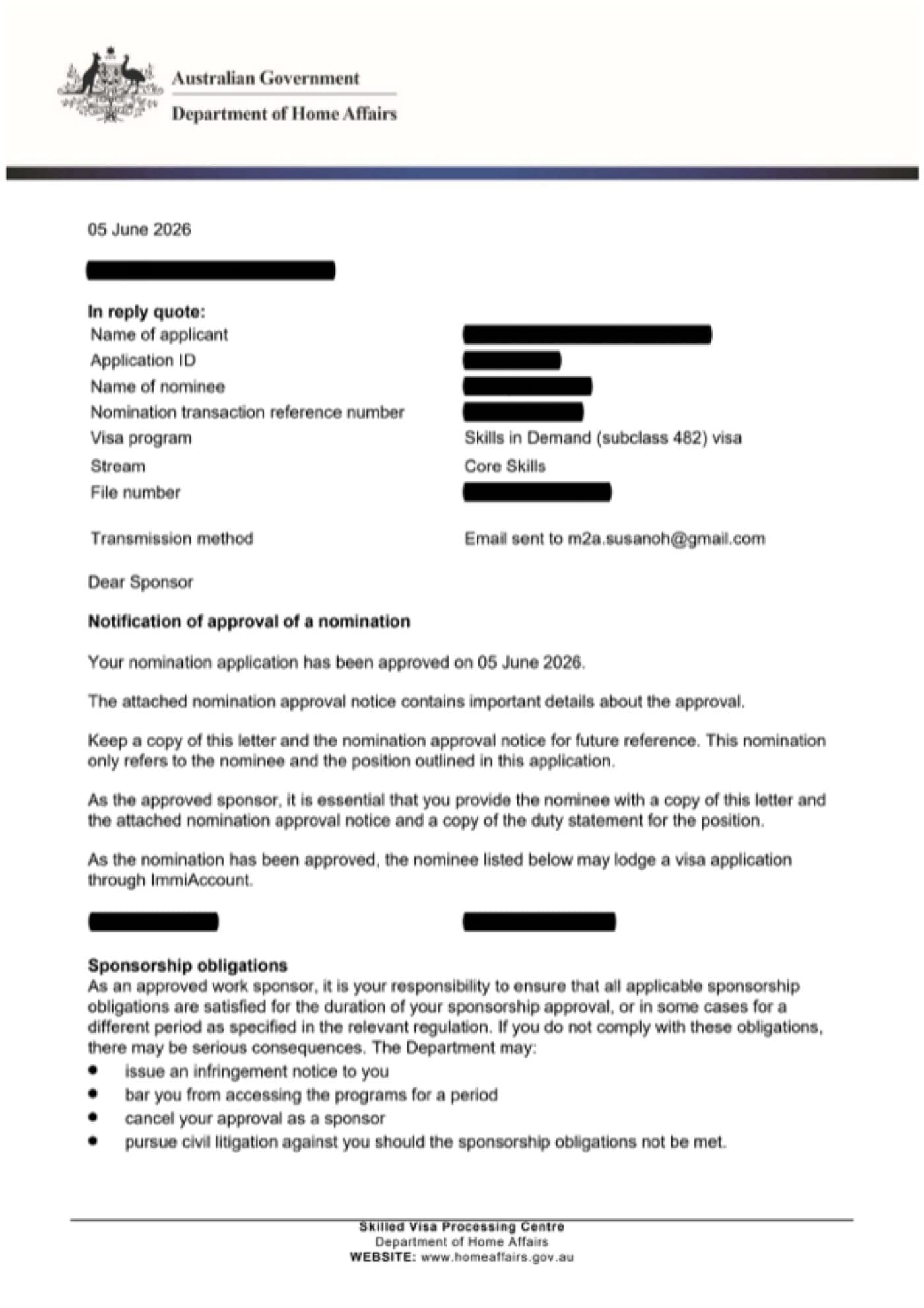
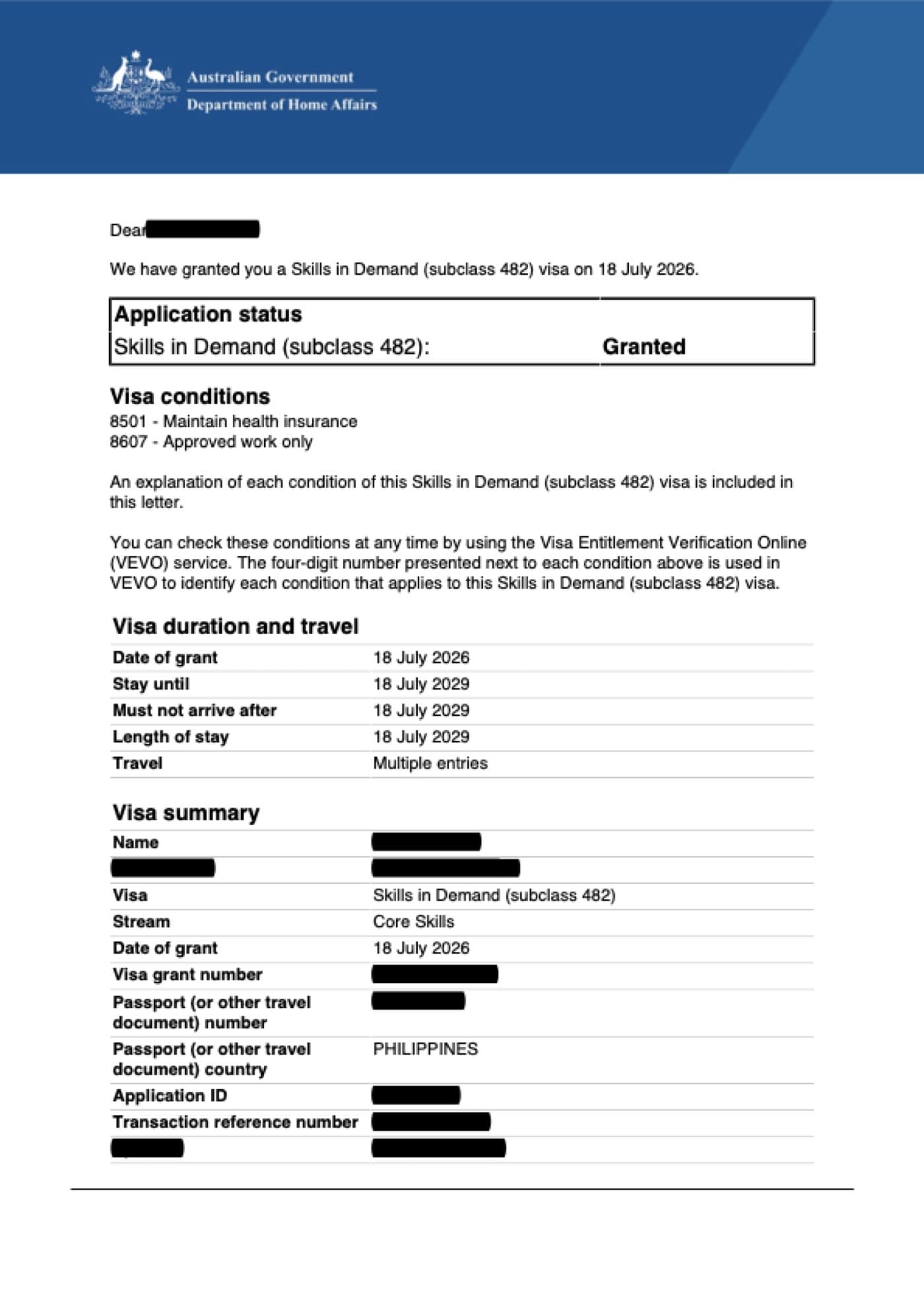
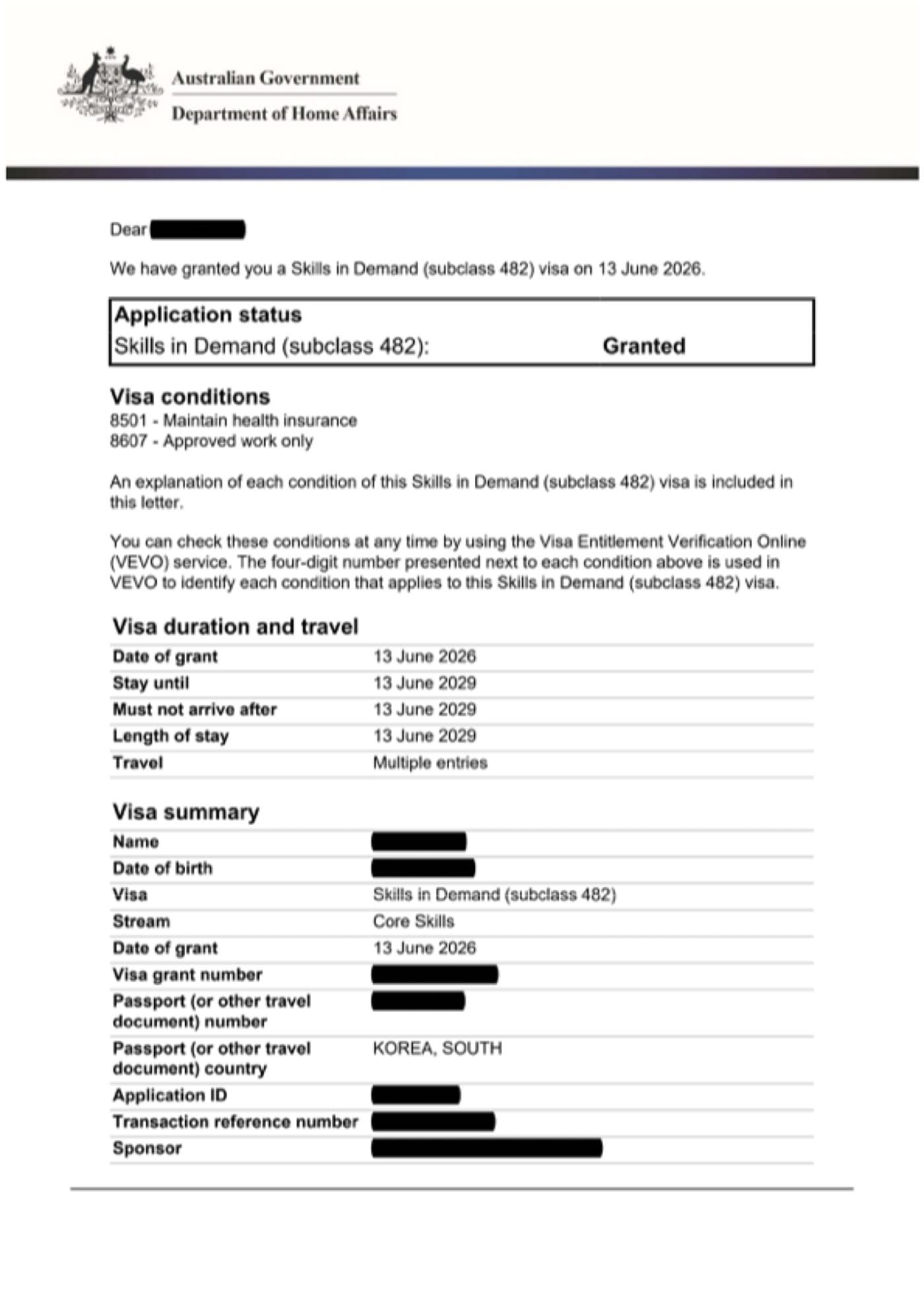
We would rather show you the results
View case results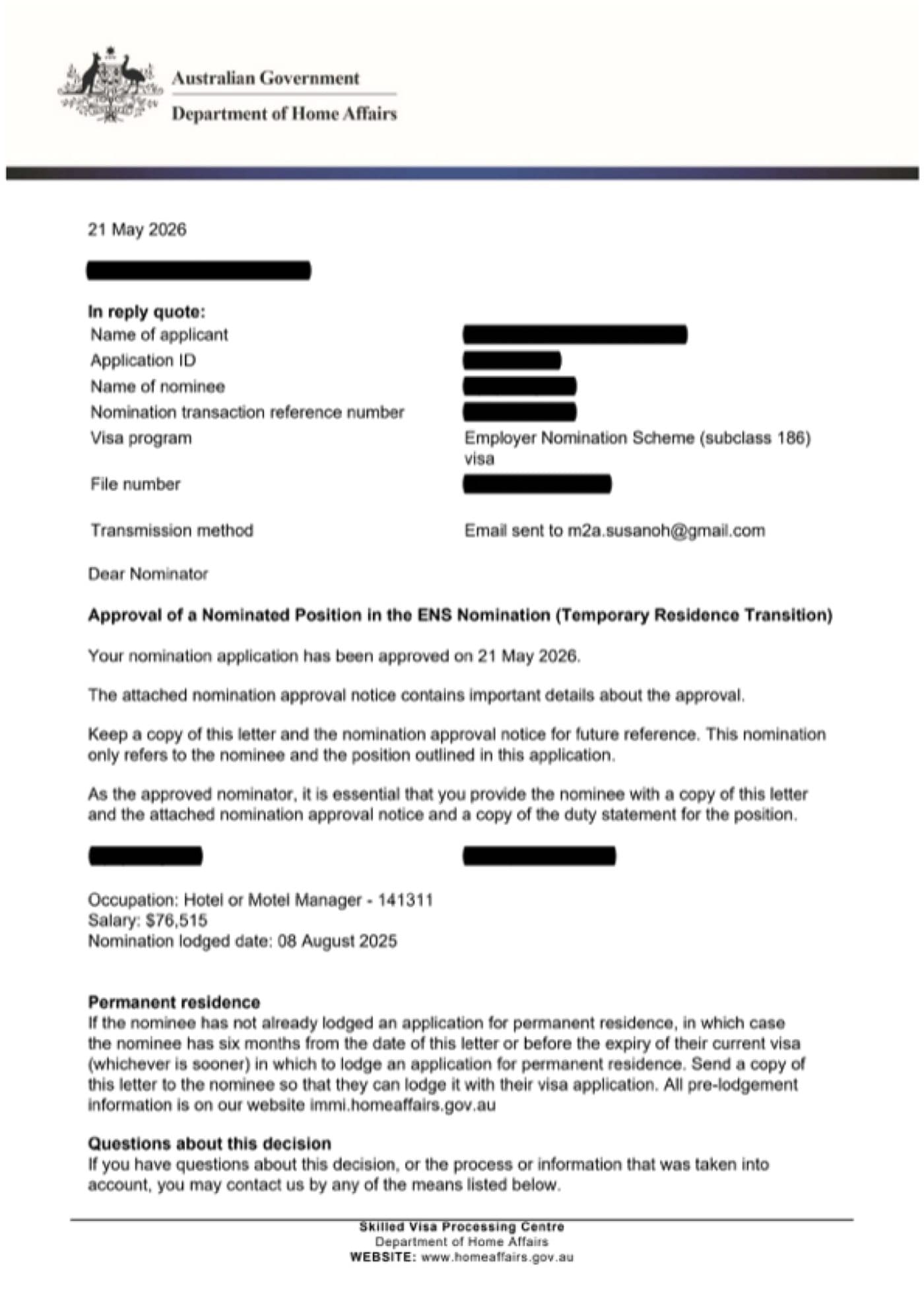
Visa services
Employer Sponsored · Skilled Migration · Family Visa · ART and Complex Cases We find the visa pathway that fits your circumstances.
View all servicesEmployer Sponsored Visa
Employer Sponsored Visa
Subclass 482 · 186 · 494
The main work-based migration pathway. An Australian employer sponsors you, and the role can lead through to permanent residence.

Skilled Migration
Skilled Migration
Subclass 189 · 190 · 491 · 191
Points-tested independent migration, state nomination and regional pathways that lead to permanent residence without employer sponsorship.

Family Visa
Family and Partner Visas
Partner · Parent · Child
The pathways to living in Australia with your family, from spouse and de facto partner visas through to parent, child and other relative visas.

ART and Complex Cases
ART Review and Complex Cases
Tribunal Review · Ministerial Intervention
A refusal or cancellation is not always the end. We handle applications to the ART and the difficult waiver cases that sit outside the usual process.
Have you received a visa refusal or cancellation notice?
Applications to the ART are subject to strict time limits, and those limits vary considerably depending on the visa and how you were notified. Once the deadline passes, your right to apply is lost regardless of the reason. If you have received a notice, contact us first. We will start by calculating how much time you have left.
Questions we are asked before consultations
01Can I migrate with a low English score?+
In many cases a pathway remains open. English is not a requirement for migration as a whole; it is set separately for each visa.
Skilled visas (189 · 190 · 491) are points tested, so your English score converts directly into points; with a lower score the difficulty lies in receiving an invitation rather than in lodging. Employer sponsored visas set the requirement comparatively lower, and the threshold varies by occupation and stream. Partner visas do not require an English score at the application stage.
Several tests are accepted, including IELTS, PTE and TOEFL, and the conversion scales differ, so the same level of ability can produce different results depending on which test you sit. Show us your current results and we will set out which pathways are open at that score, and what you would need to raise, and by how much, to open others.
02Is permanent residence difficult if I am older?+
Age is a disadvantage, but it does not close the door on its own. The effect differs entirely depending on the pathway.
In points-tested skilled migration, the 25–32 age bracket attracts the highest age points, and points reduce from there. At 45 you can no longer apply for most skilled and employer sponsored permanent visas. That age limit applies at the time of application, so whether you lodge before a birthday can genuinely decide the outcome.
Family and partner visas, by contrast, have no age limit, and some visas provide age exemptions for particular occupations or long-term residents. Before giving up on the basis of age, it is worth checking whether there is a pathway you could still lodge within the time available.
03Can a 482 visa lead to permanent residence?+
Yes. Subclass 482 (Skills in Demand) is the main pathway into the subclass 186 TRT stream. It is not automatic, though; you have to meet the requirements separately.
On the current framework, the TRT stream requires two years of work in the nominated position with the nominating employer within the last three years. Alongside the period worked, the assessment also considers whether the position being nominated is the same one held on the 482, and whether the employer intends to continue providing it on a full-time basis.
So in practice the decisive step is the occupation code (ANZSCO) chosen at the very start, when the work visa is lodged. If the code does not match the actual duties, or is one that works against a permanent transition, the problem surfaces after two years, by which point it is difficult to unwind. That is why the 482 stage should already be designed with permanent residence in view.
04How does the 482 visa differ from the old TSS visa?+
From 7 December 2024, subclass 482 changed from Temporary Skill Shortage (TSS) to Skills in Demand (SID). The subclass number is the same, but a good deal of the substance has changed.
There are three main changes. First, the short-term (STSOL) and medium-term (MLTSSL) division was replaced by three streams: Core Skills, Specialist Skills and Labour Agreement. Second, occupation lists were consolidated into the Core Skills Occupation List (CSOL), which brought in occupations that were not previously included. Third, the work experience requirement was relaxed to one year within the last five, and the period required for a permanent transition was shortened.
A case that was assessed as ineligible in the past may now produce a different answer. If you are working from advice received a few years ago, it is worth checking again.
05Is 65 points enough for skilled migration?+
65 points is only the minimum to lodge an Expression of Interest; it does not guarantee an invitation. This is where most of the misunderstanding arises.
In practice, invitations are commonly issued well above that mark, depending on how many applicants have accumulated in an occupation group. At the same 65 points, a less competitive occupation may be invited while a popular one may wait years without an invitation.
So a consultation does not stop at calculating your score. We look at whether an invitation is realistically achievable at your current score; which components you could raise (English, work experience, qualifications, state nomination, partner points); and whether there is an alternative that avoids the points competition altogether (190, 491 or employer sponsorship).
06Do I have to obtain a skills assessment?+
For points-tested skilled migration and the 186 Direct Entry stream it is effectively mandatory. Each occupation has a designated assessing authority, and the qualification and experience standards, and the document formats required, differ between them.
The issue that most often arises is how much of your experience is recognised. The number of years you count and the number the authority accepts frequently differ, and where a qualification does not align with the duties, whole periods can be excluded. Since this figure underpins the points calculation, an error here destabilises the entire plan.
Assessment outcomes have a validity period, and generally must be no more than three years old at the time of application. If you already hold one, start by checking the date of issue.
07Which state is best for nomination (190 · 491)?+
There is no state that is always the better option. Each state sets its own nomination criteria annually and changes them during the programme year, and the relative advantage flips entirely depending on where places were allocated that year.
Beyond the occupation list, most states impose additional requirements such as residence or employment history in the state, holding a job offer, English scores and settlement funds. Nomination also carries a commitment to live and work in that state for a period, so we do not recommend applying to a state you have no connection with purely on the points.
In a consultation we shortlist the states where nomination is realistic given your circumstances, and check whether the additional documents and residence requirements for each fit your actual plans.
08An employer has offered to sponsor me. What should I check?+
The employer's willingness alone is not enough. There are separate requirements the business must meet, and cases do stall at that point.
There are four main things to check. Whether the business is genuinely operating and in a position to be approved as a sponsor; whether the position falls within a nominatable occupation; whether the salary offered clears both the market salary rate and the minimum income threshold; and, where required, whether the labour market testing (LMT) advertising requirements have been met.
One point to be clear about: the costs of sponsorship and nomination, including the Skilling Australians Fund levy, must legally be borne by the employer and cannot be passed on to you. If you have been asked to cover them, seek advice before proceeding.
09My visa is about to expire. What do I do?+
Lodging your next application before the expiry date matters more than anything else. If you lodge before expiry, a bridging visa keeps your stay lawful while the application is assessed, and in most cases you can continue on conditions equivalent to your existing visa.
If you lodge after expiry, you become unlawful. That restricts onshore applications, and where you can apply you have to argue separately for a waiver of the Schedule 3 criteria, which raises both the difficulty and the cost considerably. An exclusion period may also apply.
If your current visa carries a condition such as 8503 (No Further Stay), you are barred from applying for another visa within Australia at all, and you must first apply to have the condition waived. If your expiry is approaching, contact us as soon as possible with your grant notice to hand.
10If my visa is refused, can I apply again?+
It depends entirely on the reason for refusal. And before considering a fresh application, the first thing to establish is the deadline for a review application.
Where documents were incomplete or a point was not properly addressed, correcting and reapplying may be faster. But a refusal for providing false or misleading information (PIC 4020) bars an application altogether for a period, and a character-related refusal (Migration Act s501) affects every subsequent application.
Most refusal decisions can be taken to the ART for review, but the time limits are very short and the date they run from differs depending on the visa and how you were notified. Those limits are not extended for any reason. If you have received a refusal notice, contact us with the decision record. We will start with calculating the time you have left.
11Could a health condition or past criminal record be a problem?+
Both are assessed as separate requirements, and they sometimes cause problems in ways applicants do not anticipate.
The health requirement is assessed less on the condition itself than on whether it would result in significant cost to Australia's healthcare and community services. So a condition that does not affect daily life can still fall foul of it, and in some cases the health of family members who are not applying with you is also assessed. Depending on the visa, a health waiver may be available.
The character requirement in principle calls for police certificates from every country you have lived in for 12 months or more over the past ten years. Matters you consider long past, or believe to have been expunged, may still be disclosable, so rather than omitting them, it is safer to raise them at the consultation and prepare supporting material. A failure to disclose can itself escalate into a PIC 4020 issue.
12Can my spouse and children apply with me?+
Most visas allow you to include a spouse or de facto partner and dependent children in the application. Where they are granted together, they hold the same visa conditions.
Including family members does increase government charges per person, and each family member must meet the health and character requirements. If you have school-age children, public school fee arrangements vary by visa type and by state, so it is worth checking in advance.
There are also pathways for family to join you later, where you marry or a child is born after the visa is granted, for example, but the process and timing differ by visa. If you have plans in this area, telling us at the first application stage helps in setting the overall timeline.
13Can I lodge without a migration agent?+
You can, and in some cases you should. Where the requirements are clear and the documents straightforward, doing it yourself is the cheaper option.
Where we would suggest getting advice is any case turning on a judgement that is hard to reverse: choosing an occupation code, structuring relationship evidence, assessing whether sponsorship requirements are met, or lodging while unlawful. In cases like these, the cost of correcting a badly lodged application far exceeds the cost of engaging someone at the outset.
In a consultation we will also tell you if yours is a case you could handle yourself. If we do not think you need us, we will say so.
14How long does processing take?+
It varies considerably by visa type and by when you lodge, and the processing time statistics published by the Department change constantly. Promising a specific timeframe is not something any migration agent can honestly do.
That said, even for the same visa, applications lodged complete from the outset are decided noticeably faster. A single request for further information (RFI) adds the time taken to respond and pushes the case back in the queue, so submitting everything up front is in practice the fastest route.
In a consultation we will go through the current published processing times for your visa, along with the factors that could delay your particular case, such as obtaining overseas documents, health referrals, waiting on a skills assessment and so on.
15What should I bring to a consultation?+
You can attend without preparing anything. That said, the following material lets us give much more specific answers at the first consultation.
Your passport, the grant notice for your current visa, evidence of qualifications, employment references or a CV, and your English test results. If you have had a refusal or cancellation, the complete decision record matters most. If you are looking at employer sponsorship, the company name, the duties involved and the salary offered are useful.
Material provided is not used for any purpose other than the consultation and your application, and Registered Migration Agents are bound by the Code of Conduct to keep client information confidential.
Worth checking first
Official Australian Government tools you can use yourself before a consultation.
- 01
Skilled migration points calculator
Enter your age, English score, work experience and qualifications for an immediate estimate of your skilled migration points.
Home Affairs - 02
Check visa details and conditions (VEVO)
Check the type and expiry of your current visa, and its work and study conditions, directly through VEVO.
Home Affairs - 03
Visa processing times
The latest processing times by visa type, updated monthly by the Department of Home Affairs.
Home Affairs - 04
Occupation code search (ANZSCO)
Find the ANZSCO occupation code that matches your duties. The first thing to settle in any migration plan.
ANZSCO - 05
Visa pricing estimator
Enter the visa type and accompanying family members to estimate the charges payable to the government.
Home Affairs - 06
Skills assessing authorities
Find out which authority assesses skills for your occupation.
Home Affairs - 07
Designated regional areas
Check by postcode whether an area meets the residence conditions for subclass 491 and 494 visas.
Home Affairs - 08
Check an agent's registration
Check a migration agent's registration status by MARN. Ours is 2218004.
OMARA
What our clients say
Genuine Google reviews left by clients we have worked with.
Google rating 5.0★★★★★